

Risk as an Integral Part of Business
Every entrepreneurial activity involves a certain degree of risk, which can range from the possibility of failure for a startup to reputational damage for established companies. According to the Bureau of Labor Statistics, about 20% of new businesses fail within the first year, while 50% don’t make it past five years. Identifying and managing risks effectively is essential to ensure the stability and growth of a business.
Assessing and mitigating risk
To develop an effective risk management strategy, businesses must follow several key steps:
Risk identification: Analyze potential threats, such as economic instability, competition, damage to intellectual property, or unexpected operational issues.
Probability and impact analysis: Assess the likelihood of a risk occurring and the consequences it could have on the business.
Definition of mitigation strategies: Decide whether to avoid, reduce, transfer, or accept a particular risk.
For example, the giant Blockbuster did not properly assess the risk of digital innovation and the rise of streaming, leading to its failure in 2010 due to competition from Netflix.
Risk Management Strategies
There are several ways to manage business risks:
Avoiding the risk: Modify processes, suppliers, or strategies to reduce exposure to certain threats.
Reducing the risk: Implement safety measures, internal controls, and procedures to minimize damages.
Transferring the risk: Take out insurance policies to protect against unforeseen losses.
Accepting the risk: In some cases, it may be beneficial to monitor the risk without taking direct action.
A notable example is Toyota, which, after the supply chain crisis caused by the 2011 earthquake in Japan, diversified its supply chains to reduce the risk of dependence on a single source.
The Importance of Diversification
Startups often concentrate on a single market or product, exposing themselves to greater risk in case of unfavorable changes. Larger companies, on the other hand, tend to diversify to spread risk across multiple sectors. For example:
Focused strategy: Concentrating on a single idea can lead to high gains but also increases exposure.
Diversification: Spreading investments across multiple areas reduces the negative impact of unforeseen events.
A success story is Instagram, which started as Burbn, a location-based app, but reinvented itself as an image-sharing social network to meet market needs. Similarly, Amazon, originally an online bookstore, expanded its offerings to become a giant in e-commerce and cloud computing.
Insurance Protection for Businesses
One way to transfer risk is by taking out appropriate insurance policies. Some of the main coverages available include:
Inventory and Materials Coverage: Protects the replacement value of equipment and goods.
Property Insurance: Covers damage from fires, structural failures, collapses, or pipe breakages.
Civil and Professional Liability: Protects against damages caused to third parties or professional errors.
Legal Protection: Covers legal expenses in case of disputes.
Business Interruption Insurance: Compensates for financial losses caused by events that disrupt business operations.
According to a report by Allianz, 43% of small businesses without insurance coverage close after a natural disaster, highlighting the importance of protecting one’s business from unforeseen events.
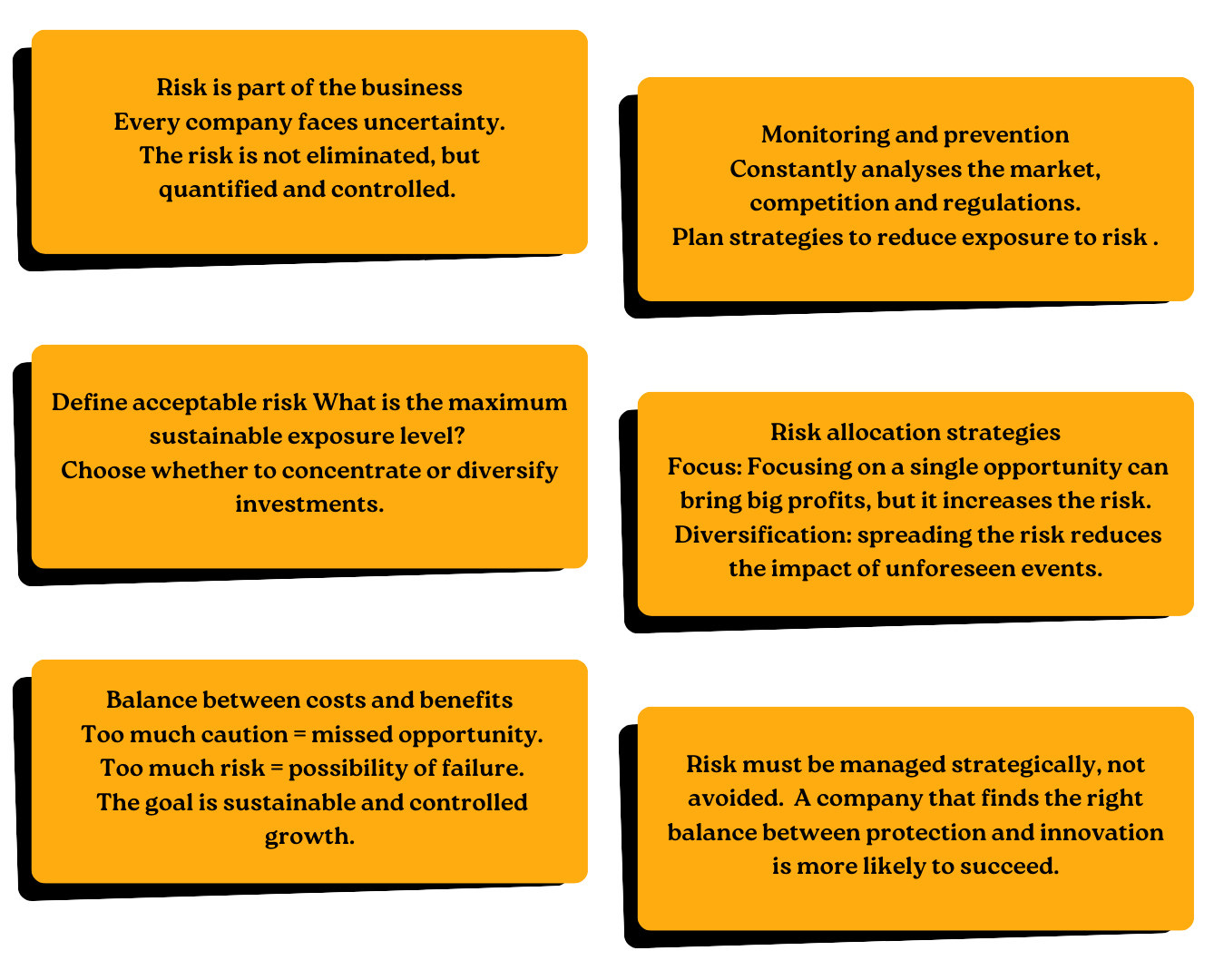
Risk is part of the business - Every company faces uncertainty. Risk is not eliminated, but quantified and controlled.
Risk cannot be eliminated, but it can be identified, quantified, and managed. A strategic approach to risk management allows businesses to face uncertainty with greater confidence and seize growth opportunities without compromising their financial stability. Major companies like Apple and Tesla have demonstrated that addressing risk through innovation and diversification strategies can lead to a lasting competitive advantage.
Download the risk assessment diagram.
Helps prioritize the most critical threats.
Supports planning of appropriate mitigation strategies.
Provides a clear and visual decision-making tool for risk management.